Volume 10, Issue 1 (Journal of Clinical and Basic Research (JCBR) 2026)
jcbr 2026, 10(1): 37-41 |
Back to browse issues page



Download citation:
BibTeX | RIS | EndNote | Medlars | ProCite | Reference Manager | RefWorks
Send citation to:


BibTeX | RIS | EndNote | Medlars | ProCite | Reference Manager | RefWorks
Send citation to:
Ranjbar Noei F, Jouybari L. From theory to practice: Integrating pharmacological management, the nursing process, and Watson's principles of human caring in an elderly patient with congestive heart failure: A Case Study. jcbr 2026; 10 (1) :37-41
URL: http://jcbr.goums.ac.ir/article-1-549-en.html
URL: http://jcbr.goums.ac.ir/article-1-549-en.html


1- Student Research Committee, Golestan University of Medical Sciences, Gorgan, Iran , f.rnjbr.n@gmail.com
2- Nursing Research Center, Golestan University of Medical Sciences, Gorgan, Iran
2- Nursing Research Center, Golestan University of Medical Sciences, Gorgan, Iran
Full-Text [PDF 477 kb]
(284 Downloads)
| Abstract (HTML) (772 Views)
Implementation of Watson's Caritas Processes
A seven-day nursing intervention grounded in Watson's Caritas Processes was implemented during hospitalization by combining evidence-based pharmacological management with humanistic care. Pharmacological interventions included diuretics, an ACE inhibitor, a beta-blocker, and supplemental oxygen as needed. Psychological and spiritual interventions focused on establishing a therapeutic relationship, maintaining therapeutic presence, strengthening hope, providing culturally appropriate spiritual support (prayer and Quranic recitation with the patient's consent), and educating the family through simple methods such as visual aids and standard containers. The patient was subsequently followed for six months after discharge to evaluate clinical and caregiving outcomes. Detailed nursing actions for each Caritas Process are presented in Table 2.
Outcomes and evaluation
After the six-month intervention, evaluation at day 7 before discharge showed meaningful improvements in clinical, psychological, and functional outcomes. A detailed summary of outcomes, including oxygenation, dyspnea, fluid management, exercise tolerance, anxiety, patient and family education, and self-care participation, is presented in Table 3.
Discussion
This case report demonstrates that integrating Watson's Human Caring Theory into the nursing process of an 85-year-old CHF patient can lead to meaningful improvements across multiple domains. After six months, the patient showed improved oxygenation (SpO2 from 92% to 95%), reduced dyspnea (9/10 to 3/10), decreased weight (1.5 kg) and edema (+2 to trace), improved functional status (From bed rest to sitting on a chair for five minutes), reduced anxiety (8/10 to 3/10), regained partial self-care (Feeding and face washing), and successful family learning of home monitoring. These findings indicate that Watson's Caritas Processes can be operationalized even in elderly, illiterate, and physically limited patients (16).
Regarding clinical outcomes, improvements in oxygenation, dyspnea, and edema were achieved through a combination of pharmacological management and humanistic care. Studies such as that by Tsao et al. (1) primarily emphasize pharmacological management of CHF but often give less attention to the psychosocial dimensions that influence treatment adherence. In contrast, the present findings suggest that combining medical treatment with caritas-based care, including empathetic communication and spiritual support, not only improved physiological parameters but also strengthened the patient's willingness to adhere to fluid restriction and daily weighing. This finding is consistent with Moradi et al. (5), who reported that quality of life in CHF patients is strongly influenced by psychological support.
Regarding anxiety and psychological well-being, the patient's self-reported anxiety decreased from 8/10 to 3/10, and she stated that she felt calmer. This improvement can be attributed to Watson's principles of therapeutic presence, empathetic communication, and strengthening hope. The nurse's conscious presence and caring intention, which are core elements of Watson's theory (9,10), created a sense of security for the patient. Unlike purely biomedical approaches that may reduce symptoms temporarily while leaving emotional distress unaddressed, Watson's framework actively involves the nurse in facilitating self-compassion and meaning-making. For example, asking the patient, "What is your best memory?" helped shift her focus from illness to positive life experiences, a strategy also emphasized by Kelkar et al. (3) for reducing depression in CHF patients.
Regarding family education and self-care participation, the patient's family successfully learned daily weight monitoring, fluid restriction using a standard cup, and recognition of danger signs. The patient also regained partial independence in feeding and washing her face. This achievement is particularly important given her illiteracy and advanced age. Arrey (7) found that digital education, such as self-care applications, can prevent readmissions in CHF; however, such methods are not suitable for elderly and illiterate patients. The present case demonstrates that education combined with human care, including face-to-face conversations, simple images, and therapeutic touch, can increase patient and family acceptance in low-resource settings. Gupta et al. (6) reported that CHF readmissions are often preventable through proper family education; our findings support this observation and further suggest that culturally appropriate, non-digital methods may be equally effective.
Regarding realistic goal-setting, a distinctive aspect of this case was the emphasis on achievable goals, such as sitting on a chair rather than walking. This approach helped prevent hopelessness and functional decline, which are common among elderly CHF patients with severe functional limitations. Montano (8) applied the Neuman Systems Model to CHF management, emphasizing balance among patient systems and environmental stressors. While the Neuman model focuses on stress prevention, Watson's theory supports the patient's coping with illness-related stress by creating a deep human connection. Both theories emphasize relapse prevention; however, Watson's approach also strengthens intrinsic motivation through meaning-making and hope-building.
Regarding spiritual and existential dimensions, the use of spiritual techniques such as prayer and Quranic recitation, in accordance with Watson's Caritas Process of attending to spiritual dimensions, helped the patient cope with illness and increased her motivation for self-care. Al-Fayyadh et al. (9) emphasized spirituality as a core concept in nursing theoretical literature, and the present case confirms its practical applicability in an elderly Muslim patient with CHF. Koseoglu et al. (11) discussed creativity in organizational behavior; in nursing care, this concept may be translated into creative problem-solving, such as using images rather than written materials for an illiterate patient.
Regarding the novelty and contribution of this case study, Watson's Human Caring Theory has been applied in various clinical settings; however, most previous reports have focused on younger, literate, and functionally independent populations. To our knowledge, this is the first case study to explicitly operationalize all Ten Caritas Processes in an 85-year-old, illiterate CHF patient with baseline functional dependence (Bedridden). In addition, the six-month follow-up period is substantially longer than that of typical case studies, which often report outcomes over only days to weeks. The practical nursing actions presented in Table 2 provide a reproducible guide for nurses in low- and middle-income countries, particularly for geriatric patients with limited health literacy and functional reserve.
This study is a single case report, which limits generalizability. The absence of a control group and reliance on self-reported anxiety scores may introduce bias. The findings may also not be transferable to younger patients or to populations with different spiritual beliefs.
In response to the main research question of whether Watson's Human Caring Theory can be effectively integrated into CHF nursing care for elderly, physically limited patient, this case provides a clear affirmative answer. The integration was feasible, acceptable to the patient and family, and associated with meaningful improvements despite the patient's advanced age, illiteracy, and functional limitations. We conclude that Watson's Caritas Processes, when combined with realistic goal-setting, family engagement, and culturally appropriate spiritual support, offer a valuable framework for holistic CHF care in low-resource settings.
Conclusion
This case report suggests that integrating Watson's Human Caring Theory into the nursing process for an 85-year-old patient with CHF and prior hospital readmissions was associated with improvements in oxygenation, dyspnea, edema, functional status, anxiety, self-care, and family engagement. Following a seven-day nursing intervention and six months of follow-up, no hospital readmissions occurred. This case illustrates the feasibility of integrating Watson's Caritas Processes into holistic nursing care for elderly, illiterate patient with complex care needs. However, as a single case study, these findings should be interpreted with caution.
This case also highlights the value of family involvement, culturally appropriate spiritual support, and realistic goal-setting based on the patient's functional capacity. Further studies with larger samples and controlled designs are needed to evaluate the effectiveness and transferability of this approach across different settings.
Acknowledgement
We would like to thank the patient and her husband for participating in this study.
Funding Sources
Self-funded.
Ethical Statement
This study was approved by the Ethics Committee of Golestan University of Medical Sciences (IR.GOUMS.REC.1404.565). In accordance with ethical principles for research involving human participants, written informed consent was obtained from the patient before participation and publication of this case report. Patient confidentiality and privacy were maintained throughout the study, and all identifying information was protected.
Conflicts of Interest
The authors declare no conflicts of interest.
Author Contributions
F.R.N.: Conceptualization, Investigation (Intervention implementation and Data collection), Formal Analysis, and Writing – Original Draft. L.J.: Conceptualization, Methodology, Validation (Verification of data interpretation), Supervision, and Writing – Review & Editing.
Data Availability Statement
Data will remain confidential and available from the first author.
Use of Artificial Intelligence
Not used. No generative AI or large language models were used in the preparation of this manuscript.
Full-Text: (116 Views)
Introduction
Congestive heart failure (CHF) is a pathophysiological condition in which the heart is unable to meet the metabolic demands of body tissues (1). Globally, CHF affects 64.34 million people, with an overall mortality rate of 9.91 per 100,000, and estimated treatment costs reaching 346.17 billion US dollars (2). More than 80% of cardiovascular diseases, including heart failure, occur in non-Western low- and middle-income countries, where mortality rates are higher than those in high-income countries (3,4).
CHF is associated with various physical and psychological complications, including fatigue, depression, anxiety, edema, and shortness of breath, all of which substantially reduce patients' quality of life (5). Poor quality of life is associated with longer hospital stays, higher mortality rates, and increased costs for health systems, families, and patients (6). Although heart failure has no definitive cure, patients can maintain a better quality of life through close collaboration with healthcare teams (7). Accordingly, various nursing care models have been proposed to guide effective care for these patients (8).
However, CHF patients also experience psychological and existential challenges that extend beyond physical symptoms. These challenges include fear of becoming a burden to family members, hopelessness about the future, loss of meaning in daily life, spiritual distress, and reduced engagement in self-care, all of which may contribute to treatment non-adherence and recurrent hospital readmissions (5,6). Importantly, purely biomedical or pharmacological management cannot fully address these non-physical dimensions of suffering (7). Spirituality and existential dimensions have therefore been recognized as core concepts in nursing theoretical literature (9).
Watson's Human Caring Theory directly addresses these gaps. Through its 10 Caritas Processes (Originally carative factors), the theory emphasizes therapeutic presence, empathetic communication, the instillation of hope and faith, acceptance of positive and negative emotions, creation of a supportive environment, and attention to spiritual and existential dimensions of care (10). These elements are particularly relevant for CHF patients experiencing anxiety, hopelessness, and loss of meaning. Watson's framework, combined with caring-healing modalities, offers a creative problem-solving approach to nursing care (11).
Unlike previous studies that have applied Watson's theory mainly in younger and literate populations, the present case study focuses on an under-reported population: elderly, illiterate, multimorbid CHF patient with severe functional limitations. The novelty of this report lies in providing a practical, step-by-step model for integrating the Ten Caritas Processes with realistic goal-setting (e.g., sitting on a chair rather than walking) and culturally appropriate spiritual support in a low-resource setting. Watson's Human Caring Theory has been successfully applied in other chronic conditions, including hemodialysis (12), schizophrenia caregiver support (13), and non-communicable diseases such as diabetes and hypertension (14), particularly for addressing psychological and spiritual dimensions. This case study describes the integration of Watson's 10 Caritas Processes into the nursing process of an 85-year-old CHF patient and evaluates outcomes over a six-month period.
Case Presentation
Patient information
The patient, Ms. M.L., was an 85-year-old married Muslim woman of Persian (Fars) ethnicity from northern Iran. She lived with her husband in an urban area and had three adult children (Two daughters and one son), who visited regularly and provided family support. Her educational level was elementary school (Completed 5th grade), and she was unable to read or write medical information; therefore, educational materials had to be delivered verbally and through images. She had worked throughout life as a homemaker. Her cultural background emphasized family cohesion, respect for elders, and reliance on spiritual practices, including prayer and recitation of the Quran, during illness.
Medical history and reason for selection
The patient had a confirmed diagnosis of congestive heart failure (CHF) with reduced ejection fraction (HFrEF) during the previous four years. Echocardiography performed three months before admission showed a left ventricular ejection fraction (LVEF) of 35%. Her comorbidities included hypertension (Diagnosed 10 years earlier and controlled with enalapril) and osteoarthritis of both knees, which limited mobility. She had no history of diabetes mellitus, thyroid disease, or renal failure.
The patient was selected as a clinical case for three reasons. First, she had experienced frequent hospital readmissions, with three admissions during the previous six months due to CHF exacerbation (Dyspnea, Weight gain, and Edema), each lasting five to seven days. Second, she reported severe anxiety (Self-reported) and hopelessness about her future, stating, "I am afraid I will become a burden to my children." Third, despite standard pharmacological management, her quality of life remained poor, and she demonstrated low engagement in self-care activities such as fluid restriction and daily weight monitoring.
Presentation at admission
At the index admission to the Cardiac Care Unit (CCU), the patient presented with dyspnea at rest and oxygen saturation of 92% on room air. Clinical examination revealed bilateral lower-extremity +2 pitting edema, and the patient had gained 2 kilograms during the two days before admission. Her vital signs included a heart rate of 98 beats per minute, blood pressure of 110/70 mmHg, and respiratory rate of 24 breaths per minute. The patient expressed marked anxiety, stating, "I can't even get out of bed. What will happen to me?" She also expressed hopelessness, saying, "I don't think I will ever get better."
Comprehensive patient assessment (Based on Watson's framework)
Before implementing the nursing intervention based on Watson's Human Caring Theory, a systematic and comprehensive patient assessment was conducted using in-depth informal interviews as the primary method. This assessment was performed during the first three days of hospitalization through multiple 20-30-minute empathetic conversations with the patient and her family members (Husband and daughters). The interview questions were open-ended and guided by Watson's Ten Caritas Processes, with emphasis on identifying the patient's physical, emotional, spiritual, cultural, and family-related needs. The following dimensions were explored:
Congestive heart failure (CHF) is a pathophysiological condition in which the heart is unable to meet the metabolic demands of body tissues (1). Globally, CHF affects 64.34 million people, with an overall mortality rate of 9.91 per 100,000, and estimated treatment costs reaching 346.17 billion US dollars (2). More than 80% of cardiovascular diseases, including heart failure, occur in non-Western low- and middle-income countries, where mortality rates are higher than those in high-income countries (3,4).
CHF is associated with various physical and psychological complications, including fatigue, depression, anxiety, edema, and shortness of breath, all of which substantially reduce patients' quality of life (5). Poor quality of life is associated with longer hospital stays, higher mortality rates, and increased costs for health systems, families, and patients (6). Although heart failure has no definitive cure, patients can maintain a better quality of life through close collaboration with healthcare teams (7). Accordingly, various nursing care models have been proposed to guide effective care for these patients (8).
However, CHF patients also experience psychological and existential challenges that extend beyond physical symptoms. These challenges include fear of becoming a burden to family members, hopelessness about the future, loss of meaning in daily life, spiritual distress, and reduced engagement in self-care, all of which may contribute to treatment non-adherence and recurrent hospital readmissions (5,6). Importantly, purely biomedical or pharmacological management cannot fully address these non-physical dimensions of suffering (7). Spirituality and existential dimensions have therefore been recognized as core concepts in nursing theoretical literature (9).
Watson's Human Caring Theory directly addresses these gaps. Through its 10 Caritas Processes (Originally carative factors), the theory emphasizes therapeutic presence, empathetic communication, the instillation of hope and faith, acceptance of positive and negative emotions, creation of a supportive environment, and attention to spiritual and existential dimensions of care (10). These elements are particularly relevant for CHF patients experiencing anxiety, hopelessness, and loss of meaning. Watson's framework, combined with caring-healing modalities, offers a creative problem-solving approach to nursing care (11).
Unlike previous studies that have applied Watson's theory mainly in younger and literate populations, the present case study focuses on an under-reported population: elderly, illiterate, multimorbid CHF patient with severe functional limitations. The novelty of this report lies in providing a practical, step-by-step model for integrating the Ten Caritas Processes with realistic goal-setting (e.g., sitting on a chair rather than walking) and culturally appropriate spiritual support in a low-resource setting. Watson's Human Caring Theory has been successfully applied in other chronic conditions, including hemodialysis (12), schizophrenia caregiver support (13), and non-communicable diseases such as diabetes and hypertension (14), particularly for addressing psychological and spiritual dimensions. This case study describes the integration of Watson's 10 Caritas Processes into the nursing process of an 85-year-old CHF patient and evaluates outcomes over a six-month period.
Case Presentation
Patient information
The patient, Ms. M.L., was an 85-year-old married Muslim woman of Persian (Fars) ethnicity from northern Iran. She lived with her husband in an urban area and had three adult children (Two daughters and one son), who visited regularly and provided family support. Her educational level was elementary school (Completed 5th grade), and she was unable to read or write medical information; therefore, educational materials had to be delivered verbally and through images. She had worked throughout life as a homemaker. Her cultural background emphasized family cohesion, respect for elders, and reliance on spiritual practices, including prayer and recitation of the Quran, during illness.
Medical history and reason for selection
The patient had a confirmed diagnosis of congestive heart failure (CHF) with reduced ejection fraction (HFrEF) during the previous four years. Echocardiography performed three months before admission showed a left ventricular ejection fraction (LVEF) of 35%. Her comorbidities included hypertension (Diagnosed 10 years earlier and controlled with enalapril) and osteoarthritis of both knees, which limited mobility. She had no history of diabetes mellitus, thyroid disease, or renal failure.
The patient was selected as a clinical case for three reasons. First, she had experienced frequent hospital readmissions, with three admissions during the previous six months due to CHF exacerbation (Dyspnea, Weight gain, and Edema), each lasting five to seven days. Second, she reported severe anxiety (Self-reported) and hopelessness about her future, stating, "I am afraid I will become a burden to my children." Third, despite standard pharmacological management, her quality of life remained poor, and she demonstrated low engagement in self-care activities such as fluid restriction and daily weight monitoring.
Presentation at admission
At the index admission to the Cardiac Care Unit (CCU), the patient presented with dyspnea at rest and oxygen saturation of 92% on room air. Clinical examination revealed bilateral lower-extremity +2 pitting edema, and the patient had gained 2 kilograms during the two days before admission. Her vital signs included a heart rate of 98 beats per minute, blood pressure of 110/70 mmHg, and respiratory rate of 24 breaths per minute. The patient expressed marked anxiety, stating, "I can't even get out of bed. What will happen to me?" She also expressed hopelessness, saying, "I don't think I will ever get better."
Comprehensive patient assessment (Based on Watson's framework)
Before implementing the nursing intervention based on Watson's Human Caring Theory, a systematic and comprehensive patient assessment was conducted using in-depth informal interviews as the primary method. This assessment was performed during the first three days of hospitalization through multiple 20-30-minute empathetic conversations with the patient and her family members (Husband and daughters). The interview questions were open-ended and guided by Watson's Ten Caritas Processes, with emphasis on identifying the patient's physical, emotional, spiritual, cultural, and family-related needs. The following dimensions were explored:
- Emotional status: The patient was verbally asked about her fears, worries, and sources of hope. Her anxiety level was assessed using a validated single‑item Numerical Rating Scale for Anxiety (NRS‑A), ranging from 0 ("no anxiety") to 10 ("worst possible anxiety") (15), on which she self‑reported a score of 8/10. She also explicitly stated, "I am afraid I will become a burden to my children," indicating hopelessness about her future.
- Spiritual needs: The patient was asked about her spiritual and religious practices. She actively requested opportunities to recite prayers and listen to soothing Quranic recitation during stressful moments, explaining that her faith had always given her strength.
- Family support and knowledge: The family's understanding of CHF management, including fluid restriction, daily weight monitoring, and recognition of danger signs, was assessed through open-ended questions. The family provided adequate emotional support but lacked practical knowledge.
- Cultural factors: As a Persian Muslim elder, the patient valued respect, privacy, and family involvement in decision-making. She expressed discomfort with direct eye contact from male staff when asked about her preferences, which guided the decision to provide all nursing care through female nurses.
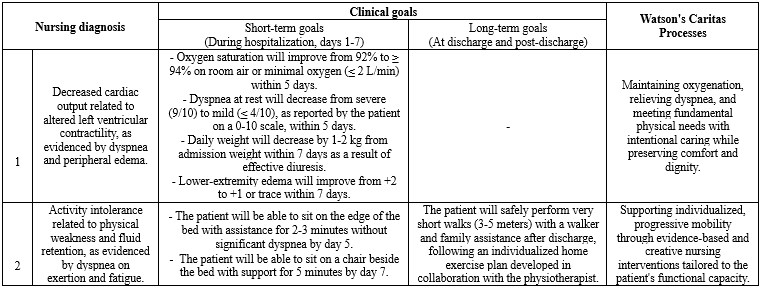
Based on this systematic assessment, four nursing diagnoses were identified, and short-term and long-term goals were established, as presented in Table 1. This assessment ensured that all subsequent nursing interventions were individualized, needs-based, and grounded in the patient's real-life context.
|
Table 1. Nursing Diagnoses, Clinical Goals, and Watson's Caritas Processes
 .PNG) |
|
Table 2. Nursing Interventions Based on Watson's Caritas Process
.PNG) |
A seven-day nursing intervention grounded in Watson's Caritas Processes was implemented during hospitalization by combining evidence-based pharmacological management with humanistic care. Pharmacological interventions included diuretics, an ACE inhibitor, a beta-blocker, and supplemental oxygen as needed. Psychological and spiritual interventions focused on establishing a therapeutic relationship, maintaining therapeutic presence, strengthening hope, providing culturally appropriate spiritual support (prayer and Quranic recitation with the patient's consent), and educating the family through simple methods such as visual aids and standard containers. The patient was subsequently followed for six months after discharge to evaluate clinical and caregiving outcomes. Detailed nursing actions for each Caritas Process are presented in Table 2.
Outcomes and evaluation
After the six-month intervention, evaluation at day 7 before discharge showed meaningful improvements in clinical, psychological, and functional outcomes. A detailed summary of outcomes, including oxygenation, dyspnea, fluid management, exercise tolerance, anxiety, patient and family education, and self-care participation, is presented in Table 3.
|
Table 3. Patient Outcomes at Day 7 (Before Discharge)
.PNG) |
Discussion
This case report demonstrates that integrating Watson's Human Caring Theory into the nursing process of an 85-year-old CHF patient can lead to meaningful improvements across multiple domains. After six months, the patient showed improved oxygenation (SpO2 from 92% to 95%), reduced dyspnea (9/10 to 3/10), decreased weight (1.5 kg) and edema (+2 to trace), improved functional status (From bed rest to sitting on a chair for five minutes), reduced anxiety (8/10 to 3/10), regained partial self-care (Feeding and face washing), and successful family learning of home monitoring. These findings indicate that Watson's Caritas Processes can be operationalized even in elderly, illiterate, and physically limited patients (16).
Regarding clinical outcomes, improvements in oxygenation, dyspnea, and edema were achieved through a combination of pharmacological management and humanistic care. Studies such as that by Tsao et al. (1) primarily emphasize pharmacological management of CHF but often give less attention to the psychosocial dimensions that influence treatment adherence. In contrast, the present findings suggest that combining medical treatment with caritas-based care, including empathetic communication and spiritual support, not only improved physiological parameters but also strengthened the patient's willingness to adhere to fluid restriction and daily weighing. This finding is consistent with Moradi et al. (5), who reported that quality of life in CHF patients is strongly influenced by psychological support.
Regarding anxiety and psychological well-being, the patient's self-reported anxiety decreased from 8/10 to 3/10, and she stated that she felt calmer. This improvement can be attributed to Watson's principles of therapeutic presence, empathetic communication, and strengthening hope. The nurse's conscious presence and caring intention, which are core elements of Watson's theory (9,10), created a sense of security for the patient. Unlike purely biomedical approaches that may reduce symptoms temporarily while leaving emotional distress unaddressed, Watson's framework actively involves the nurse in facilitating self-compassion and meaning-making. For example, asking the patient, "What is your best memory?" helped shift her focus from illness to positive life experiences, a strategy also emphasized by Kelkar et al. (3) for reducing depression in CHF patients.
Regarding family education and self-care participation, the patient's family successfully learned daily weight monitoring, fluid restriction using a standard cup, and recognition of danger signs. The patient also regained partial independence in feeding and washing her face. This achievement is particularly important given her illiteracy and advanced age. Arrey (7) found that digital education, such as self-care applications, can prevent readmissions in CHF; however, such methods are not suitable for elderly and illiterate patients. The present case demonstrates that education combined with human care, including face-to-face conversations, simple images, and therapeutic touch, can increase patient and family acceptance in low-resource settings. Gupta et al. (6) reported that CHF readmissions are often preventable through proper family education; our findings support this observation and further suggest that culturally appropriate, non-digital methods may be equally effective.
Regarding realistic goal-setting, a distinctive aspect of this case was the emphasis on achievable goals, such as sitting on a chair rather than walking. This approach helped prevent hopelessness and functional decline, which are common among elderly CHF patients with severe functional limitations. Montano (8) applied the Neuman Systems Model to CHF management, emphasizing balance among patient systems and environmental stressors. While the Neuman model focuses on stress prevention, Watson's theory supports the patient's coping with illness-related stress by creating a deep human connection. Both theories emphasize relapse prevention; however, Watson's approach also strengthens intrinsic motivation through meaning-making and hope-building.
Regarding spiritual and existential dimensions, the use of spiritual techniques such as prayer and Quranic recitation, in accordance with Watson's Caritas Process of attending to spiritual dimensions, helped the patient cope with illness and increased her motivation for self-care. Al-Fayyadh et al. (9) emphasized spirituality as a core concept in nursing theoretical literature, and the present case confirms its practical applicability in an elderly Muslim patient with CHF. Koseoglu et al. (11) discussed creativity in organizational behavior; in nursing care, this concept may be translated into creative problem-solving, such as using images rather than written materials for an illiterate patient.
Regarding the novelty and contribution of this case study, Watson's Human Caring Theory has been applied in various clinical settings; however, most previous reports have focused on younger, literate, and functionally independent populations. To our knowledge, this is the first case study to explicitly operationalize all Ten Caritas Processes in an 85-year-old, illiterate CHF patient with baseline functional dependence (Bedridden). In addition, the six-month follow-up period is substantially longer than that of typical case studies, which often report outcomes over only days to weeks. The practical nursing actions presented in Table 2 provide a reproducible guide for nurses in low- and middle-income countries, particularly for geriatric patients with limited health literacy and functional reserve.
This study is a single case report, which limits generalizability. The absence of a control group and reliance on self-reported anxiety scores may introduce bias. The findings may also not be transferable to younger patients or to populations with different spiritual beliefs.
In response to the main research question of whether Watson's Human Caring Theory can be effectively integrated into CHF nursing care for elderly, physically limited patient, this case provides a clear affirmative answer. The integration was feasible, acceptable to the patient and family, and associated with meaningful improvements despite the patient's advanced age, illiteracy, and functional limitations. We conclude that Watson's Caritas Processes, when combined with realistic goal-setting, family engagement, and culturally appropriate spiritual support, offer a valuable framework for holistic CHF care in low-resource settings.
Conclusion
This case report suggests that integrating Watson's Human Caring Theory into the nursing process for an 85-year-old patient with CHF and prior hospital readmissions was associated with improvements in oxygenation, dyspnea, edema, functional status, anxiety, self-care, and family engagement. Following a seven-day nursing intervention and six months of follow-up, no hospital readmissions occurred. This case illustrates the feasibility of integrating Watson's Caritas Processes into holistic nursing care for elderly, illiterate patient with complex care needs. However, as a single case study, these findings should be interpreted with caution.
This case also highlights the value of family involvement, culturally appropriate spiritual support, and realistic goal-setting based on the patient's functional capacity. Further studies with larger samples and controlled designs are needed to evaluate the effectiveness and transferability of this approach across different settings.
Acknowledgement
We would like to thank the patient and her husband for participating in this study.
Funding Sources
Self-funded.
Ethical Statement
This study was approved by the Ethics Committee of Golestan University of Medical Sciences (IR.GOUMS.REC.1404.565). In accordance with ethical principles for research involving human participants, written informed consent was obtained from the patient before participation and publication of this case report. Patient confidentiality and privacy were maintained throughout the study, and all identifying information was protected.
Conflicts of Interest
The authors declare no conflicts of interest.
Author Contributions
F.R.N.: Conceptualization, Investigation (Intervention implementation and Data collection), Formal Analysis, and Writing – Original Draft. L.J.: Conceptualization, Methodology, Validation (Verification of data interpretation), Supervision, and Writing – Review & Editing.
Data Availability Statement
Data will remain confidential and available from the first author.
Use of Artificial Intelligence
Not used. No generative AI or large language models were used in the preparation of this manuscript.
Article Type: Case report |
Subject:
Nursing
Received: 2026/01/16 | Accepted: 2026/03/15 | Published: 2026/08/23 | ePublished: 2026/08/23
Received: 2026/01/16 | Accepted: 2026/03/15 | Published: 2026/08/23 | ePublished: 2026/08/23
References
1. Tsao CW, Aday AW, Almarzooq ZI, Alonso A, Beaton AZ, Bittencourt MS, et al. Heart disease and stroke statistics-2022 update: a report from the American Heart Association. Circulation. 2022;145(8):e153-e639. [View at Publisher] [DOI] [PMID] [Google Scholar]
2. Masaebi F, Salehi M, Kazemi M, Vahabi N, Azizmohammad Looha M, Zayeri F. Trend analysis of disability adjusted life years due to cardiovascular diseases: results from the global burden of disease study 2019. BMC Public Health. 2021;21(1):1268. [View at Publisher] [DOI] [PMID] [Google Scholar]
3. Kelkar AA, Spertus J, Pang P, Pierson RF, Cody RJ, Pina IL, et al. Utility of patient-reported outcome instruments in heart failure. JACC Heart Fail. 2016;4(3):165-75. [View at Publisher] [DOI] [PMID] [Google Scholar]
4. Dokainish H, Teo K, Zhu J, Roy A, AlHabib KF, ElSayed A, et al. Global mortality variations in patients with heart failure: results from the International Congestive Heart Failure (INTER-CHF) prospective cohort study. Lancet Glob Health. 2017;5(7):e665-e72. [View at Publisher] [DOI] [PMID] [Google Scholar]
5. Moradi M, Daneshi F, Behzadmehr R, Rafiemanesh H, Bouya S, Raeisi M. Quality of life of chronic heart failure patients: a systematic review and meta-analysis. Heart Fail Rev. 2020;25(6):993-1006. [View at Publisher] [DOI] [PMID] [Google Scholar]
6. Gupta A, Allen LA, Bhatt DL, Cox M, DeVore AD, Heidenreich PA, et al. Association of the hospital readmissions reduction program implementation with readmission and mortality outcomes in heart failure. JAMA Cardiology. 2018;3(1):44-53. [View at Publisher] [DOI] [PMID] [Google Scholar]
7. Arrey CM. The Use of the HF Helper Mobile Application to Reduce Rehospitalization Rates in Adults With Systolic Congestive Heart Failure. [D.N.P. dissertation]. 2025. 72 p. [View at Publisher] [Google Scholar]
8. Montano A-R. Neuman Systems Model With Nurse-Led Interprofessional Collaborative Practice. Nurs Sci Q. 2021;34(1):45-53. [View at Publisher] [DOI] [PMID] [Google Scholar]
9. Al‐Fayyadh S, Diener E, Wright V. Spirituality as a core concept in the theoretical literature of nursing: A comparative overview between Watson & Lovering's perspectives. Nurs Forum. 2022;57(4):717-23. [View at Publisher] [DOI] [PMID] [Google Scholar]
10. Watson J, Woodward TK. Jean Watson's theory of human caring: SAGE Publications Limited London, UK; 2020. [View at Publisher] [Google Scholar]
11. Koseoglu G, Shalley CE, Lemoine GJ. Every Sherlock needs a Dr. Watson: A theory of creativity catalysts in organizations. J Organ Behav. 2022;43(5):840-57. [View at Publisher] [DOI] [Google Scholar]
12. Yangöz ŞT, Özer Z. Effects of motivational interviewing and an education programme based on Watson's theory of human caring on adults receiving haemodialysis: randomised controlled trial. J Res Nurs. 2025;30(1):80-99. [View at Publisher] [DOI] [PMID] [Google Scholar]
13. Bagheri S, Zarshenas L, Rakhshan M, Sharif F, Sarani EM, Shirazi ZH, et al. Impact of Watson's human caring-based health promotion program on caregivers of individuals with schizophrenia. BMC Health Serv Res. 2023;23(1):711. [View at Publisher] [DOI] [PMID] [Google Scholar]
14. Alvarez-Bolaños E, Flores-Guadarrama MA, Guzmán-Catalán H, Tejada NABP, Anaya-Jiménez Y, Cuevas-Budhart MA. Humanization of nursing care in hospitalized patients with non-communicable diseases: a phenomenological qualitative study. BMC Nurs. 2025;25(1):102. [View at Publisher] [DOI] [PMID] [Google Scholar]
15. Prokopowicz A, Stanczykiewicz B, Uchmanowicz I. Validation of the Numerical Anxiety Rating Scale in postpartum females: a prospective observational study. Ginekol Pol. 2022;93(9):686-94. [View at Publisher] [DOI] [PMID] [Google Scholar]
16. Babaei S, Etedali M, Mousavi M-S. The effects of nursing care based on Watson's theory on self-care ability in patients with congestive heart failure. Iran J Nurs Midwifery Res. 2025;30(4):497-504. [View at Publisher] [DOI] [PMID] [Google Scholar]
Send email to the article author
| Rights and permissions | |
 |
This work is licensed under a Creative Commons Attribution-NonCommercial 4.0 International License. |

This work is licensed under a Creative Commons Attribution-NonCommercial 4.0 International (CC BY-NC 4.0).
